

Real Estate Market Intelligence June 2026

Real Estate Market Intelligence
June 2026
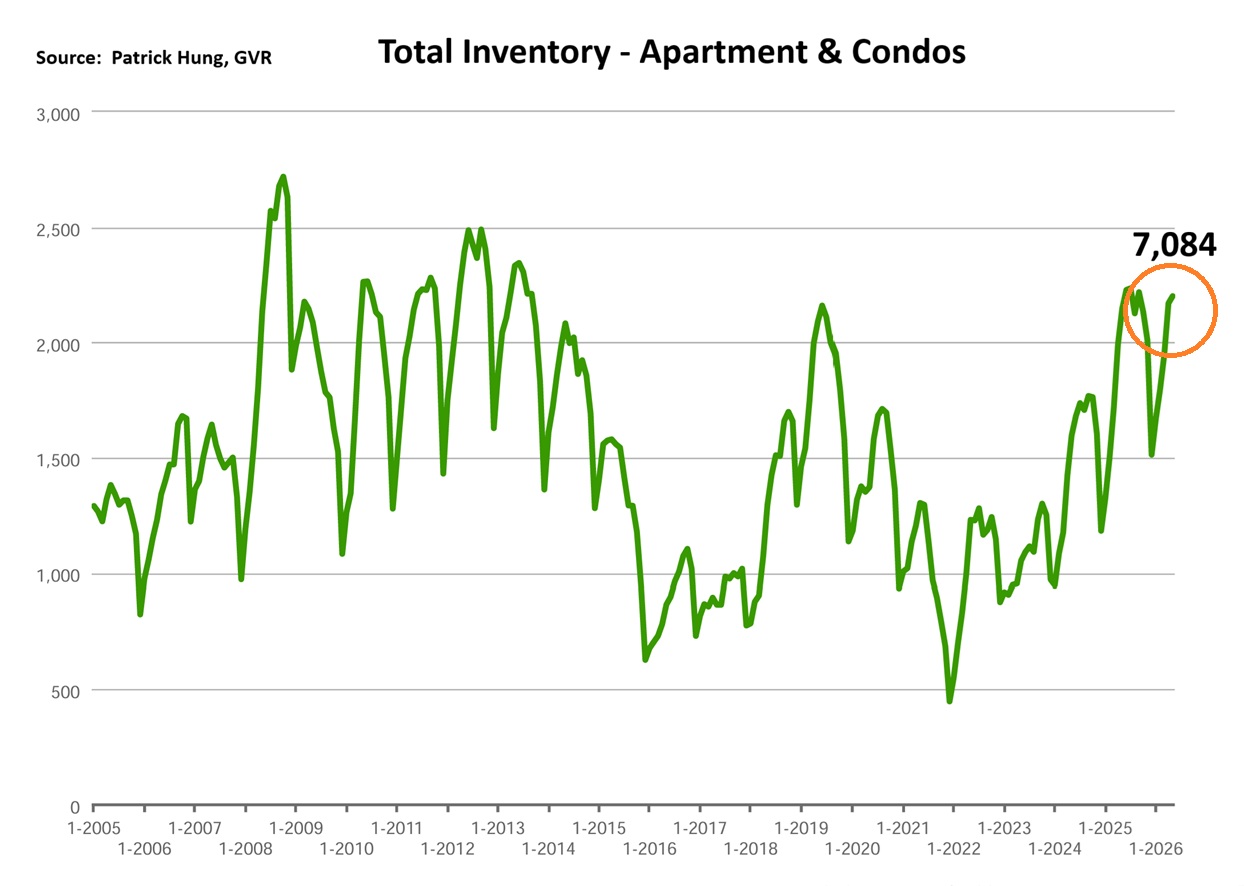
Summer has begun and so has the World Cup. The soccer fever is here but the Vancouver real estate endured another frothy month of May. Last month had the second lowest sales for the month of May in the past 25 years (first goes to May 2020, the year of the pandemic). Many had thought that this year the market would recover, but the fact is, spring did not inject any life into the Vancouver real estate, and in fact, this year was worse off than last in terms of sales. The irony remains that the market is highly segmented. On one hand, the single house sales performed better than same time last year, and total inventory is lower than that of a year ago. In other words, even the single house market is still in a Buyer's market, it's beginning to turn the page. Meanwhile, the apartment segment keeps getting hammered with a glut of inventory and with sales approx -9% less than last year. Overall, the Buyer holding pattern remains, while the general public seems to have gotten used to the volatility. The recent good news is that the US-Iran conflict may soon come to an end (at for now), and energy prices could start to ease soon. Lots to cover this month as we continue to see multiple stock markets reaching new heights, including US, Korea, and Taiwan. Meanwhile, Canada falls into a "technical" recession after two consecutive quarters, with the latest real GDP contracting for -0.1% last quarter after a -1% drop in the quarter before that. Last but not least, the Bank of Canada maintain its pattern of holding rates in their latest announcement, but with as much uncomfortable dilemma they are in now. Let's jump right in.
In May, the Vancouver real estate sales remain extremely sluggish, with total sales (demand) trending -26.6% below the 10 year average and with total inventory (supply) +34.6% above the 10 year average. The spread is 61.2 ,which is in line with the trend thorough this year. For the record, 6 months ago that same spread was hitting a record of mid 70%. In a sense, the market is improving, but it's like going from a 30 year low to a 25 year low. A developing trend that began this is that the market is become highly segmented. Single house leads the pack with steady inventory and increased sales, while apartment sales remains weak and is dragging the market downward altogether. The "missing middle" townhouse market seems to be stuck right in the middle. Historically, single houses market is the leading indicator for other segments to following suit, but this time it may be different. Anecdotally, I see many families pulling the trigger to up-size now because the gap is narrowing on such up-sizing costs. For example, some single houses in North Vancouver and Richmond are dialing back their prices back to 2021, with 5 year single house price change at +3.8% and +1.1% respectively. However, the townhouses in these same neighborhood's 5 year price change is +14.1% and +10.7% respectively. What this means is the cost of up-sizing is lowered, and Buyers (especially growing families) now have an advantage. Again, this is only for the selective Buyers, who have NOT lost their jobs nor have bought the current home at a time not long ago that they're in lost equity (i.e Buyer having bought an apartment 3 years ago which is now stuck at -10% below their cost). For this same reason, the demand remains weak not because Buyers don't want to buy, but because of the continued weak Canadian economy (i.e weak labor market and low productivity), and compounded with the geopolitical issues and war causing oil prices to spike in the past 3+ months, which lowered the overall Canadian's family's take-home income. Part of my prediction is that the second half of this year the Vancouver real estate market will become even more segmented: single house sales could recover much sooner than many anticipated, but prices will could remain flat. At the same time, apartment market may get left behind and will take much longer to recover due to its abundant supply of new developments down the pipeline.
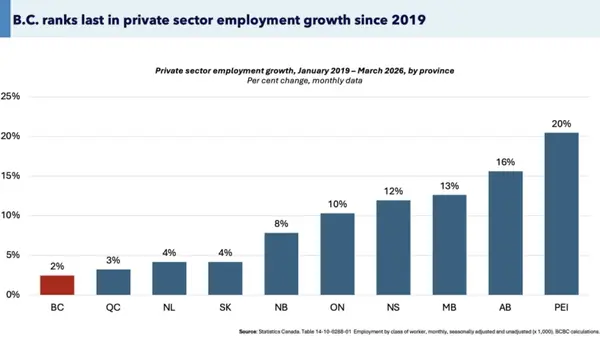
On the economic front, Canada just saw a "technical" recession after registering two consecutive quarters of negative growth with GDP contracting another -0.1% this latest quarter, after having contracted -1% the quarter before that. Again, politicians will likely dance around this with revisions to claim the -0.1% was minor, but anecdotally, I do feel that most Canadians would agree, especially those in the most populous Canadian cities like Toronto or Vancouver, that a recession was here long before the latest stats came in. In fact, Canada is so reliant on new immigrants to boost its economy that the Canadian productivity has long been lagging behind the US. The divergence is so obvious that from 2017 to 2024, we saw Canadian's overall business productivity fell -0.1%, while US surged by +10.1%. By the same token, the current US economy is bubbling over the top, with the stock market breaking records every month for the past few months. The rich in the US may rejoice, but the poor is suffering more than ever as the latest US headline inflation hit +4.2% due to the heightened energy prices. Even though Canada's latest inflation is faring a bit better at +2%, it remains to be seen how even an "agreed" peace deal in the Middle East can settle the energy and food costs.
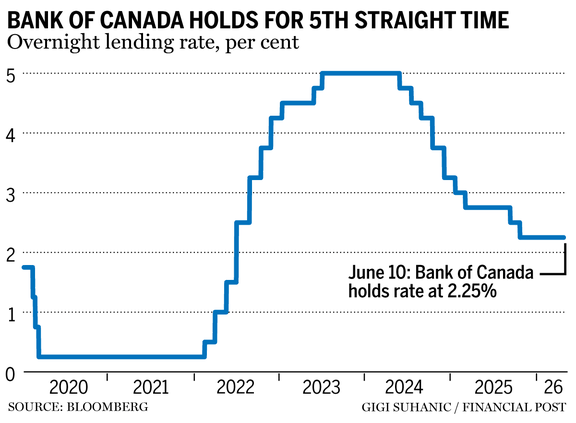
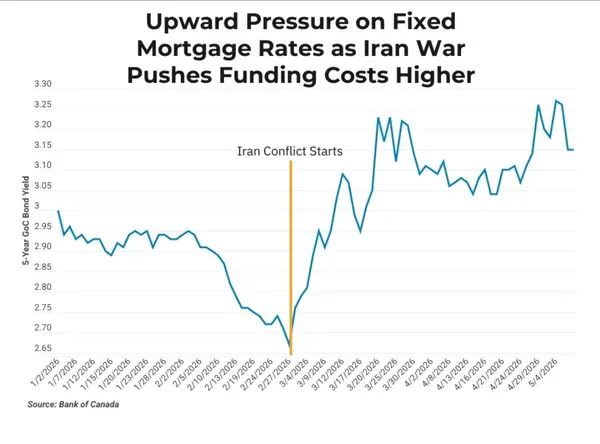
For the above reasons, it was a logical decision that the Bank of Canada held it's rates for the fifth consecutive time. They continue to be in an extreme tough spot, having to deal with a weakened Canadian economy and rising inflation. In my opinion, a rate change (either a slight rise or drop of plus/minus 0.25%) would be highly likely in the next 6-9 months. For the past few weeks, we have already seen the 5 year Canadian bond rate (which the 5 year fixed mortgage rates mirrors) spike, and forcing the major banks to hike their fixed rates by +0.4 to +0.5% during that time. Now come the interesting part: what if I'm a Buyer who locked in the bank rates 6 weeks ago, and I have 90-120 days to make a decision to buy or not? Would my decision lean towards enjoy my cheaper locked in rates, or a possible cheaper purchase price somewhere down the road? That's a trade-off some Buyers are facing, and it remains to be seen how and if this would possibly increase the sales in the already-muted Vancouver real estate market. Your guess is as good as mine. Have a wonderful early summer and wishing you a happy Canada Day weekend.
Some of the unique trends I've been observing:
1. The CUSMA (Canadian-US-Mexico Agreement) is set for renewal in July 1st, 2026. For some reason, neither of these three countries seems to be making efforts to iron out the details. It remains to be seen how a non-renewal scenario would play out. Either way, it would be war of the words between US and Canada in a already fragmented relationship. Keep in mind that Canada remains the only country that has not made a deal on the tariffs (which has since been revoked in Feb 2026).
2. Canada entered its technical recession after registering two consecutive quarters of negative GDP, with the latest one coming in at -0.1% after a -1% drop before that. Anecdotally, this year is the first time in a long time that I've seen so many restaurant and business closures. Many Canadians, especially in the most populous cities like Toronto and Vancouver, are already feeling the pain before the latest stats.
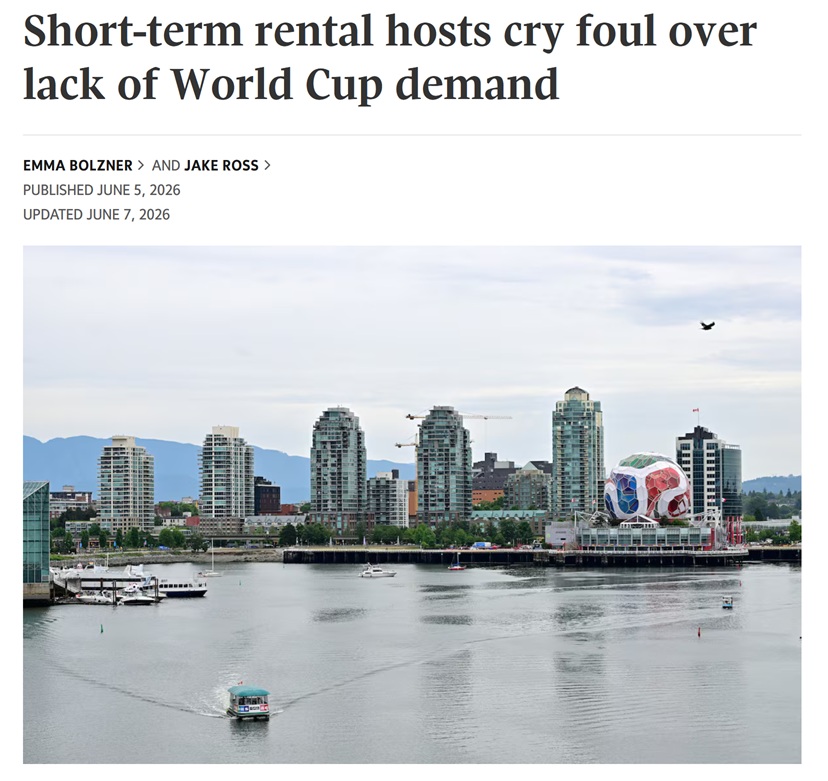
3. The World Cup has got Canada something to cheer about, but it certainly wasn't the case for AirBnB owners. Reports came in that Vancouver AirBnB's are seeing 35% less occupancy rate compared this year to last. Well, maybe one of those factors is that Vancouver is voted the best host city, yet also the most EXPENSIVE cities for hotels rates. Average nightly hotel rates are USD $890, and on peak match-day average rate it's USD $1,455 per night! If I were a tourist, I'd avoid Vancouver as well.
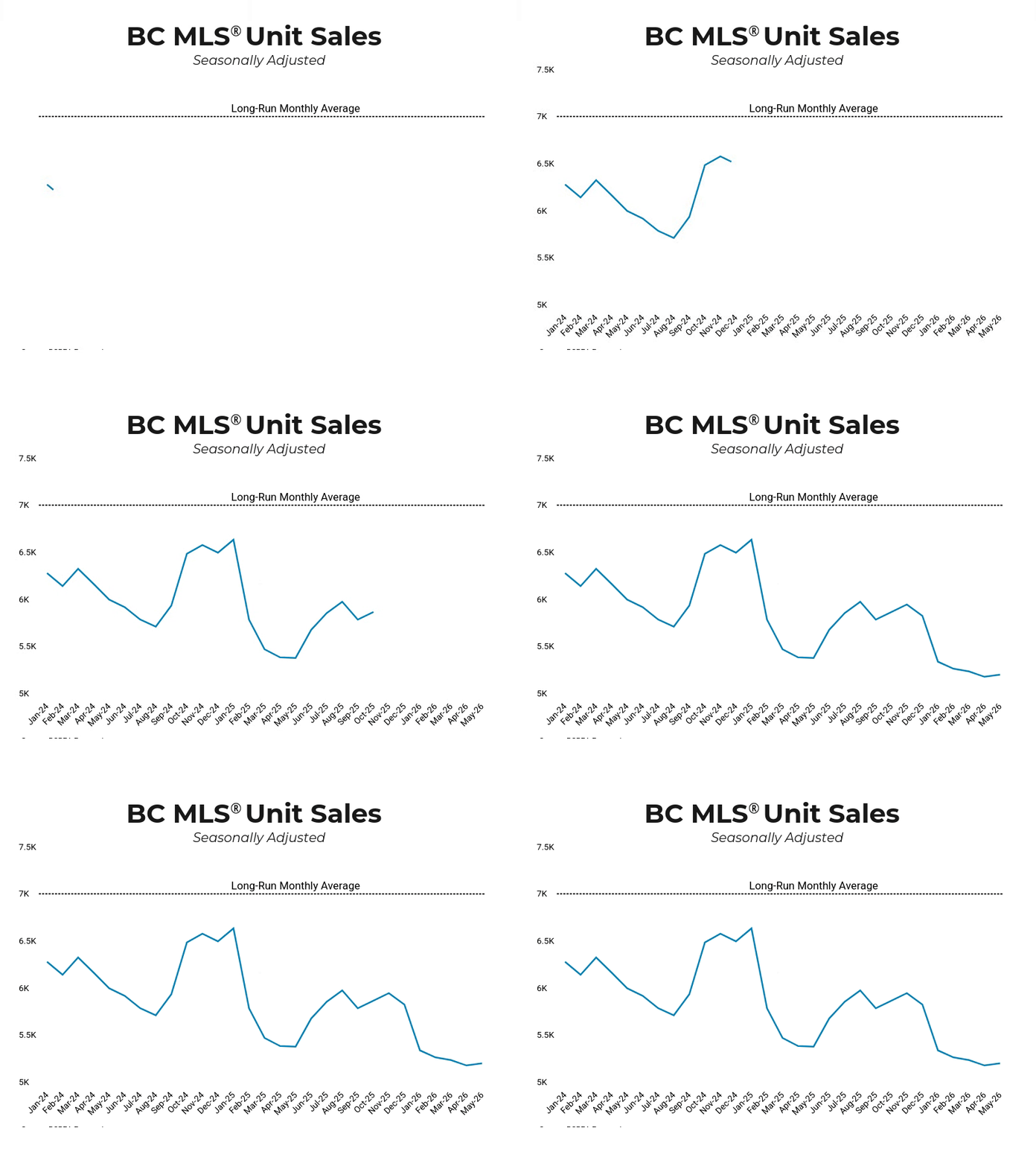
4. Spring definitely did not spring into action in terms of Vancouver real estate sales in May. Last month registered the second lowest real estate sales for May in the past 21 years (first was in May 2020, when the pandemic hit.) If you thought last years real estate was tough, this year is worst. For this same reason, many real estate agents are exiting the market. The number of agents continue to trend down by the month. In May there were 14,002 agent. Now, there's 13,923. The exodus is real.
5. Fixed mortgage rates continue to creep higher in the past 4-6 weeks, thanks to the geopolitical issues that are affecting the Canadian bond rates. During May, major banks have quietly jacked up their fixed rates by between +0.3% to +0.4%. For those Buyers who are sitting on the fence, I suggest locking in the rates as sooner than later. Some good news may be on the horizon that a final peace deal with US-Iran could be signed, which may help calm the bond rate a bit. But again, that's a big IF. And also for how long?
Here are the 3 highlights for May:
- Total inventory of 16,4880 units is the sixth highest April's total inventory in the past 21 years. Total inventory continue to soften in the single house segment, while townhouse and apartment remain in abundant supply. If the single house slowing supply continues for a few more months, we may see prices flat line soon in this segment. Again, a price recovery is still too early to say.
- Apartment sales is dragging the overall market downward, as new supply (with some now finished newly construction homes) continue to flood the market. Prices will be taking a hit in the near future. If you're an apartment or condo Seller, ensure you're home is priced sharply and make your home appealing. Literally, there's no time to waste: every month on the market that's priced wrong will cost you tens and thousands of dollars lost in equity.
- Market is now see-sawing between monthly price losses and gains for the past three months. We saw March price gain +0.4%, followed by April's -0.6%, and now May's flat at 0%. In other words, the past 3 months' price was nearly flat at -0.2%. As market sales and prices crawl sideways, it awaits to bee seen what the usually dull summer sales and price would look like.
Here are the in-depth statistics of the May:
- Last month's sales were -26.6% below the 10 year April's sales average (compared to -22.9%% in April). Feels like the May sales wanted to improve but couldn't.
- Month by month residential home sales remained nearly flat at +0.02% from April.
- Month by month new home listings dropped by -8.6%. Again this is due to seasonality, or may because of the World Cup causing some seller to pause their real estate plans.
- Last month's price was flat at 0% (compared to -0.6% in April)
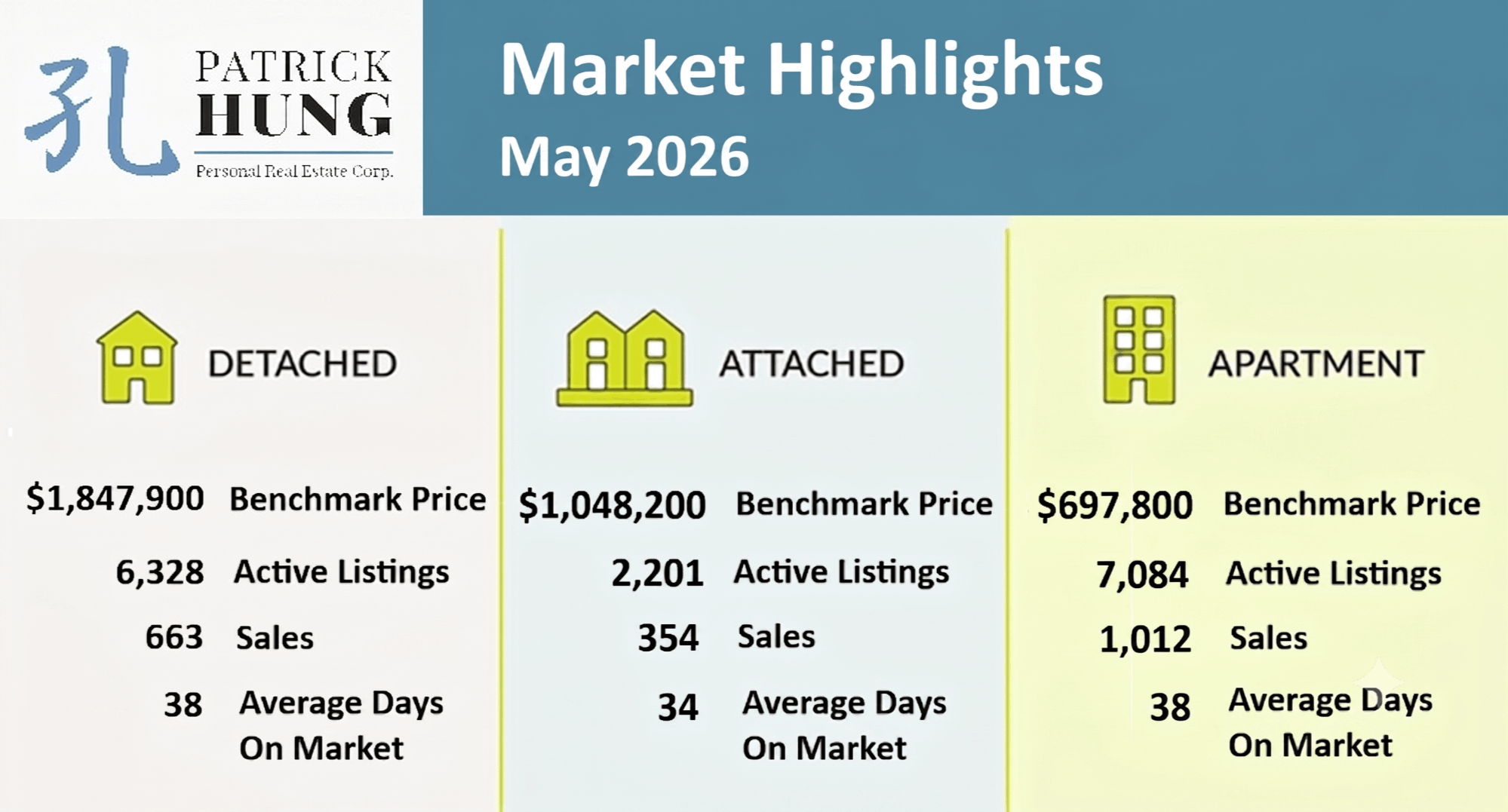
- Sales-to-listing (or % of homes sold) ratio remained relatively flat as well at 13.1% (compared to 14.2% in April). By property type, the ratio is 10.7% for single houses, 15.4% for townhouses, and 14.2% for condos.
Download Greater Vancouver Real Estate Report May 2026
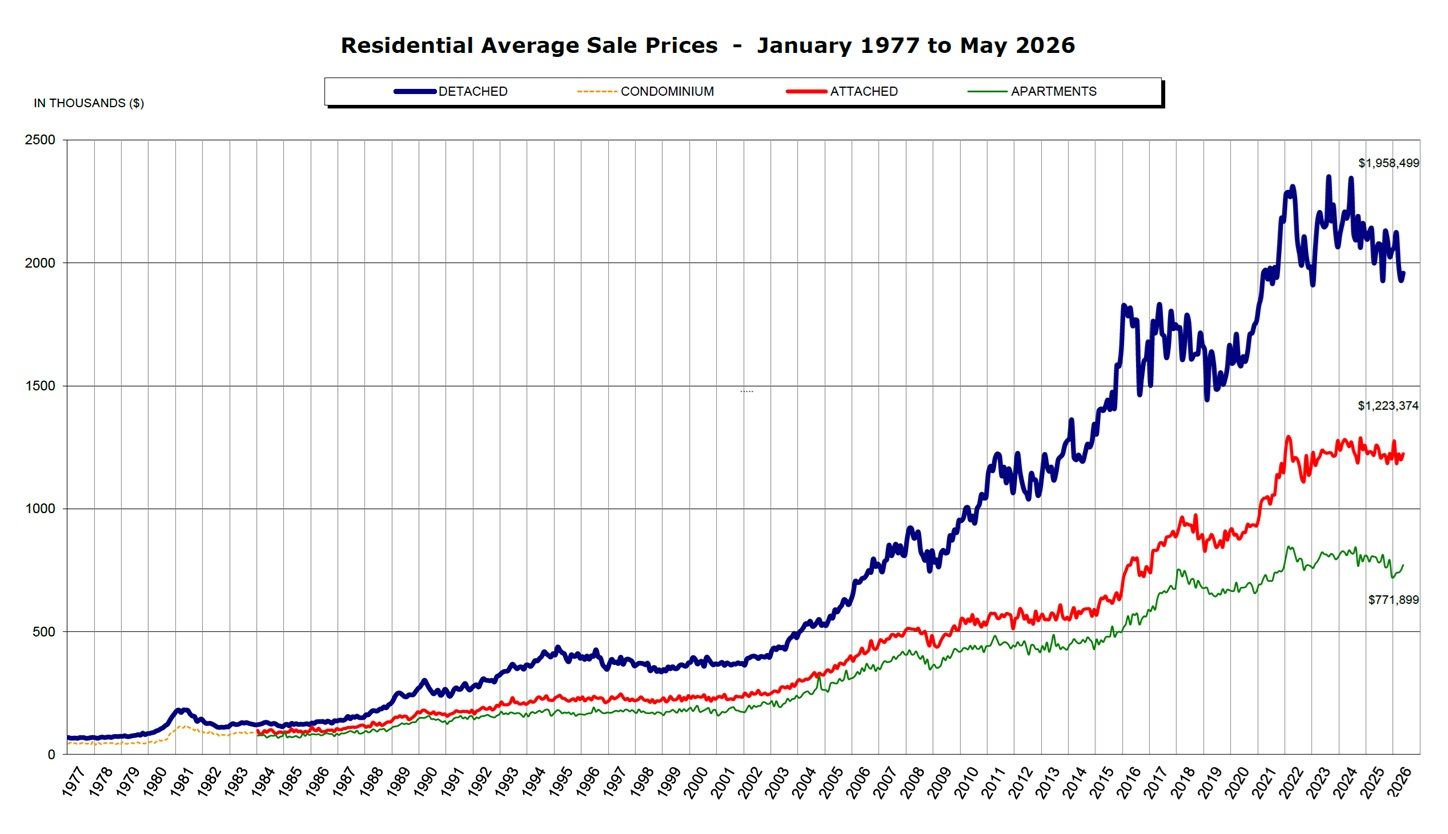
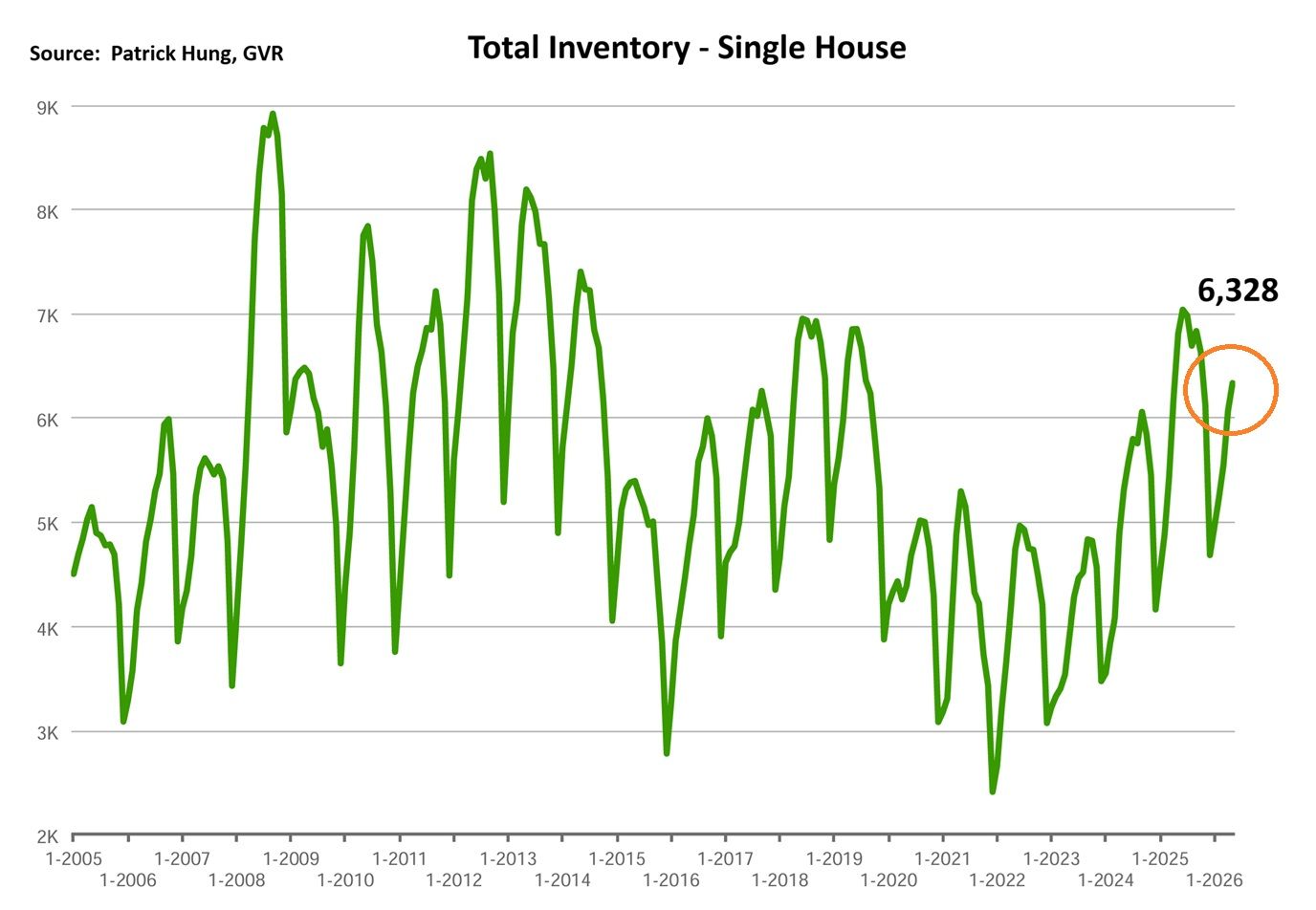
Across all segments, the single house market is the first to show signs of recovery in terms of having less supply (compared to last year) that was met with slightly increased demand of +1% (again compared to last year). After having seen the single house prices drop for the past 12 months, younger families who want and need to upsize are finding this as an great opportunity to make a move. Historically, single house is the fastest (and the leading) segment to come out of a recovery. Why? Simply put, there are nearly no new single homes being built now in metro Vancouver (but many in Langley), which is a result of higher labor, material costs, and worst of all, higher tax and permit charges from the local government. This has effectively eroded all the profits for single house builders. However, Langley, due to its affordable land value rezoned from farmlands and the lower development permit taxes and charges, are seeing a lot of newer single houses. For the best bang for the buck for single house, Langley is the place to be. Of course, real estate is hyper local and as we see pockets of neighborhood such as Vancouver Westside really woke up from the slump in May, especially in areas such Cambie, Kerrisdale, MaKenzie Heights and Mount Pleasant, with sales-to-listing ratio (% of homes sold) spiking to 22%, 24%, 25% and 25% respectively. Meanwhile, single houses in suburb areas such as Burnaby, Richmond and Tsawassen are performing subpar, registered sales-to-listing ratio at 9% across all three neigborhoods, which tightened its grip in a Buyer's market. With Vancouver's home prices always at a premium (consistently ranked the most expensive city in Canada), entry level & good conditioned homes are always in demand. Even though it's been quiet for nearly a year, it really doesn't take much for the single house market to turn. Anecdotally, we see some renovated Vancouver specials in East Vancouver (owner live upstairs with a rental suite downstairs) getting snatched up around $1.9m. It's still too early to say that a single house market recovery is in place, but there are obvious indicators that it seems to be that way moving forward.
For the month or May, the neighborhoods that registered the most price growth were Squamish, Ladner, and Tsawwassen/Sunshine Coast (tied), posting +3.7%, +2.6% and +2.5% respectively. Conversely, the neighborhoods registered the most significant price drops were Maple Ridge, New Westminster, and Burnaby East, with -2.1%, -1.9% and -1.8% respectively. The single house market shifted from a Balanced market back to a Buyer's market, with average days on market improving slightly to 38 days (compared to 40 days in April), and month-to-month sales price was nearly flat at +0.1% (compared to -0.8% in April). Sales-to-listing ratio (% of homes sold) remain nearly flat at 10.7% (compared to 11.3% in April).
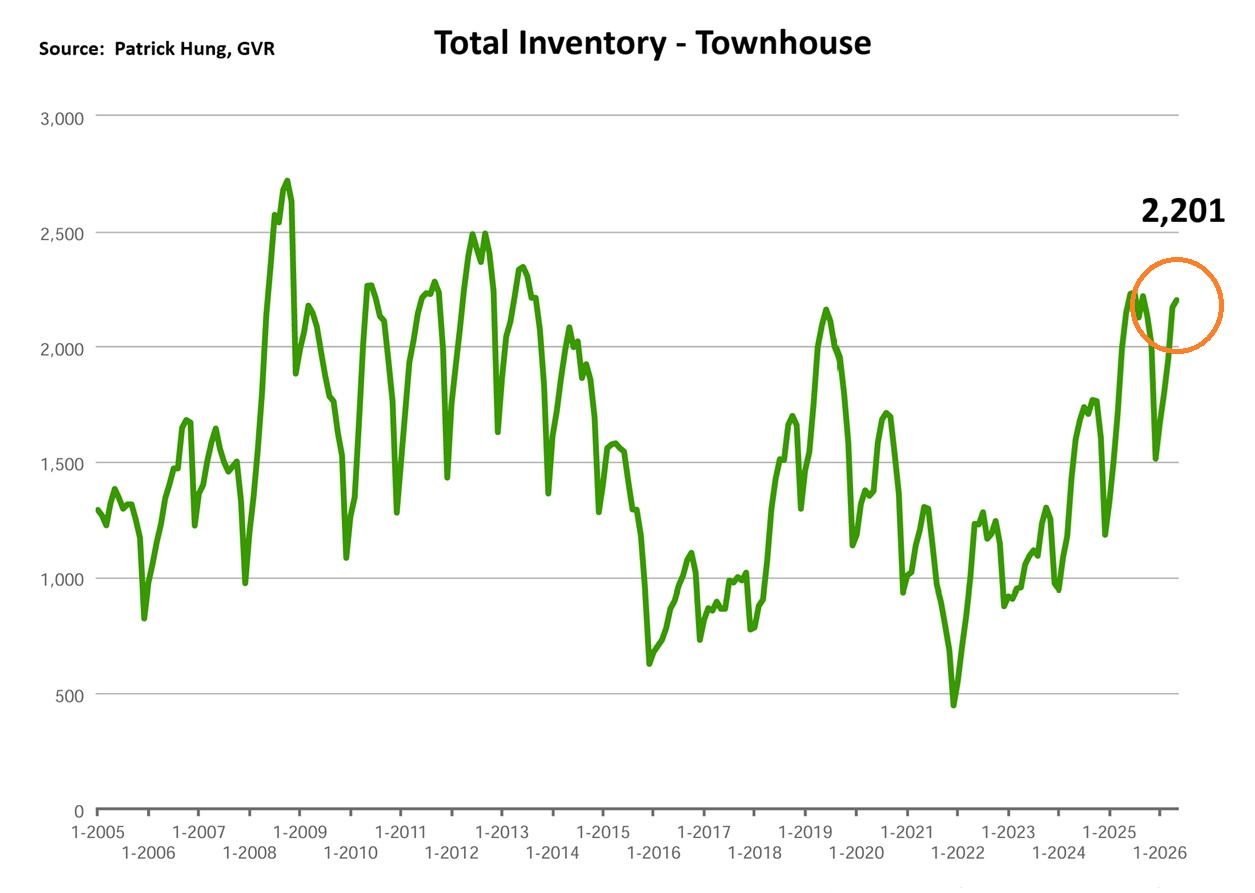
While the single house market saw softening inventory, the townhouse market is still seeing an abundant supply (but still less than apartments in that sense). A few months ago, I had an impression that the townhouse market's may be the first to recover across all segments, and I stand corrected. Anecdotally, we are seeing inventory up, and asking prices down, and to a point where entry level townhouses are becoming very attractive for young families. For example, in Surrey we are seeing more and more newer townhouses (less than 10 years old) asking under $800k, while both Richmond and Burnaby are under $1m. Even in the backdrop of elevated inventory, the townhouse market remained in the Balanced market. As reported before that this segment is always dragged along by the apartment market (where growing families sell their apartment and upsize to a townhouse), I believe this softness will continue at least for this year. Also, townhouse's new competitor, aka the newly built multi-plexes (i.e the 4, 6, 8 plexes) are becoming more popular with the younger Buyers. We will see just how much market share that eats up and how that would further affect the sales and inventory of townhouses in the upcoming months. Either way, Spring has proven to be another dull one for the townhouse market thus far.
In April, the areas with the most townhouse price growths were Burnaby South, Squamish and North Vancouver, registering +4.4%, +1.9%, and +1.4% respectively. On the other hand, the neighborhoods with the most significant price drops were Vancouver West, Vancouver East and Pitt Meadows, at -4%, -1.7% and -1.2% respectively. The townhouse market remained in a balanced market, with days on market dropping slightly to 31 days (compared to 34 days in March). Month-to-month sale price posted a minor drop of -0.4% (compared to +0.1% in March). Sales-to-listing ratio (% of homes sold) dropped slightly to 15% (compared to 17.2% in March).
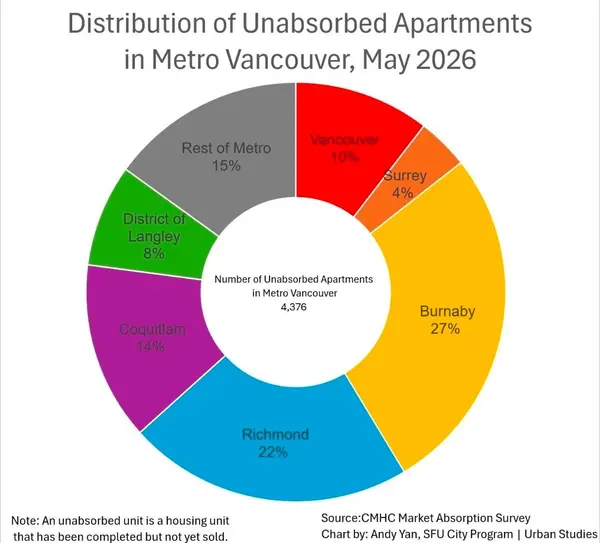
Despite the typical Spring rush, the condo market remains in a funk. In April, the monthly price dropped at -0.5%, which is mid-pack compared to single house (-0.8%) and townhouse (-0.4%). However, the condo supply shock remains the most concerning. Compound that with more nearly-complete projects finishing this year, and it's not hard to see why condo prices will trend downward this year. To put it into perspective, April's condo sales were the 3rd lowest for the month in the past 21 years, outside of 2019 and 2020 (pandemic). On a year-to-year basis, April of 2025 was a also a record low sale year, but in comparison to April 2026, this April's condo sales were even -10% less than last year. Statistically, the 1 year condo price dropped -7.9%, but anecdotally, the drop feels more like over -10%. When we account for all the new condo projects PLUS all the new immigrants in the past 21 years, AND the sales are now still trending at historic low, then one sense the magnitude of the condo supply shock we're in now. After all, the shopping frenzy for pre-sale condos that lasted over a decade in Vancouver that attracted both local retail mom-and-pops Buyers to overseas shoppers, has now flipped onto the other side. What that means is the price gap is spreading further between the pre-sale price (i.e $2500 per SF at Oakridge by Westbank) and the re-sale price ($1,320 per SF of an Oakridge condo 5 year old condo across the street). That's nearly $1,200 per SF of risk that no buyer will take. For this year and of all the segments, I'm the most bearish on condos. If I were a condo Seller now, I'd dress it up nicely and price it extremely sharp in the hopes of making a quick sale.
For the month of April, the best performing neighbourhoods for condos were in Vancouver West, Burnaby North and North Vancouver at +1.4% and +1.1% and +0.6% respectively. Conversely, the areas with the most significant price drops were all in the outskirts in Whistler, Sunshine Coast and Squamish, posting -14.7%, -14% and -13.5% respectively. The condo segment remained in a balanced market, with average days on market ending slightly higher to 40 days (compared to 38 days in March). Month-to-month sale price slipped by -0.5% (compared to -0.2% in March). Sale-to-listing (% homes sold) ratio dropped slightly as well to 14.7% (compared to 15.7% in March).
1. Hold Up
As many expected, the Bank of Canada (BoC) held it's rates for the 5th consecutive time. They are faced with tough dilemma between rising inflation due to energy prices that was met with a continued weak Canadian economy. Many economist expect the holding pattern to remain till end of this year, or with a slight +0.25% hike. If the recent news of the war in Iran can finally calm the markets, I believe the winds may change quickly, with a possible longer hold or even a cut. (Source: Bloomberg)
Vancouver just hosted its first World Cup and there were parties all over town, but not so much for AirBnB owners. It was reported that many AirBnB owners had 35% less booking on their suites compared to last year. This strange phenomenon is also happening in Toronto. Here's the math; since Oct 1, 2025, there had been 4,000 new hosts who signed up looking to capitalize on this possible once-in-a-lifetime World Cup opportunity. However, it just didn't play out. Vancouver is voted the best city to host the World Cup, but also is the most expensive one in terms of hotel overnight rates, with average nightly hotel rates at USD $890, and on peak match-day, average rate hits USD $1,455 per night! If I were a tourist, I'd avoid Vancouver as well. (Source: The Globe and Mail)
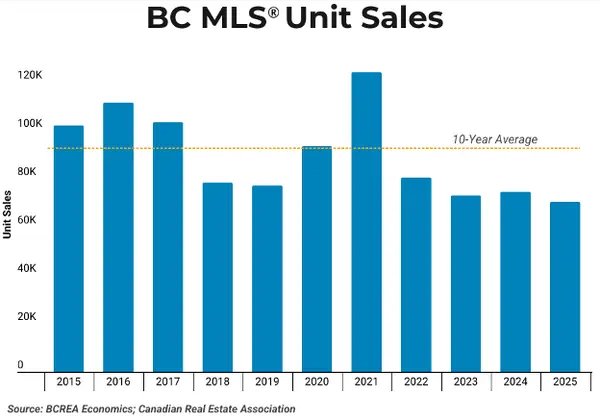
There is no way to mask the weak sales in May. In fact, it was the second lowest sales for the month of May in 21 years (2020 took the top spot, which was the pandemic year). Are we seeing a bottom, or could it go lower? Either way, I don't think we will get a "V" shaped recovery, where a sharp upturn takes place. Instead, I feel prices and sales may crawl sideways for months or years, much like a "U" shape recovery. Or maybe we land a worst case scenario much like the 80's-90's, where there was a decade of flat prices. (Source: BCREA)
Recent Posts


GET MORE INFORMATION